

zux
Developer-approvedhrzlgnm
mDNS-SD visualizer with force-directed graph visualization
Copied! Paste it into a terminal and press Enter to install.
About
This is a community package of zux, maintained by the upstream developer. It repackages the official upstream Linux build unmodified.
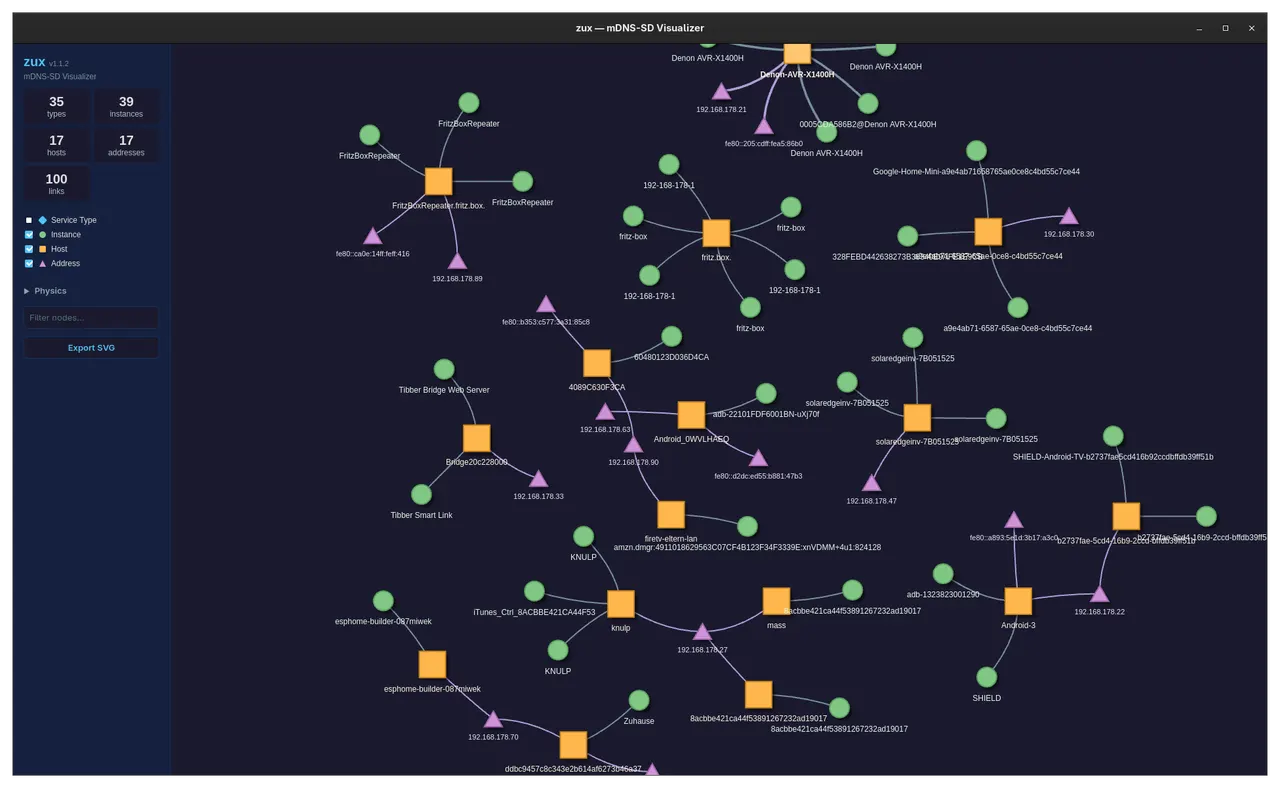
zux automatically discovers every service advertised on your local network via mDNS/DNS-SD and renders it as an interactive force-directed graph, so you can see at a glance which service types, instances, hosts and addresses are present and how they relate to one another.
- Automatic discovery of every mDNS service type announced on the network.
- Force-directed graph (vis-network) with multiple physics solvers; typed nodes are distinguished by shape and color — service types (diamond), service instances (circle), hosts (square) and IP addresses (triangle).
- Live statistics, offline detection (greyed-out instances/hosts) and a detail panel with service type, subtype, hostname, port, addresses, TXT records and clickable URLs for HTTP(S) services.
- Filtering by query, group toggling via the legend, live physics controls and SVG export.
Permissions: the sandbox shares the host network namespace (--share=network) because that is the app's whole purpose — mDNS service discovery is multicast UDP on 224.0.0.251:5353, which can only reach the host network. Beyond that the package is deliberately narrow: it has no filesystem access — files are written only through the file dialog — and there is no tray icon. The app keeps its own settings under the per-app data directory, which Flatpak redirects into ~/.var/app/io.github.hrzlgnm.zux. Nothing else needs opting into via flatpak override.
Details
- Developer
- hrzlgnm
- License
- MIT
- Version
- 1.1.3 · 2026-08-10
- Website
- Homepage
- Source
- zux
- Packaging
- flatpark/registry
Permissions
1 to review-
Network access
Can reach the internet and local network
-
Inter-process communication
Shares the IPC namespace with the host
-
X11 (fallback)
-
Wayland display
-
GPU acceleration