
Tessera
Developer-approvedPedro Henrique Quitete BarretoProprietary
Share smart card and token drivers with your other apps
Copied! Paste it into a terminal and press Enter to install.
About
This package is maintained by Tessera's developer. It installs Tessera's official release build from its GitHub releases, unmodified, and downloads each token driver from its vendor at install time, checked against a pinned checksum. One driver file is adapted: SerproID's launcher and configuration name its install folder, /usr/share/serproid-desktop, and are pointed at its copy inside the app. The drivers' install scripts never run.
Tessera lets sandboxed apps use hardware tokens, smart cards and cloud certificates without installing any driver on the system. It runs the token drivers inside its own sandbox and shares every token with other apps through p11-kit, the standard way for Linux apps to reach PKCS#11 devices.
This is meant for immutable systems such as Fedora Silverblue, Kinoite, Bluefin, Aurora and Bazzite, where installing a vendor's driver package on the host is hard or impossible.
- Shows the card readers, the inserted tokens and their certificates
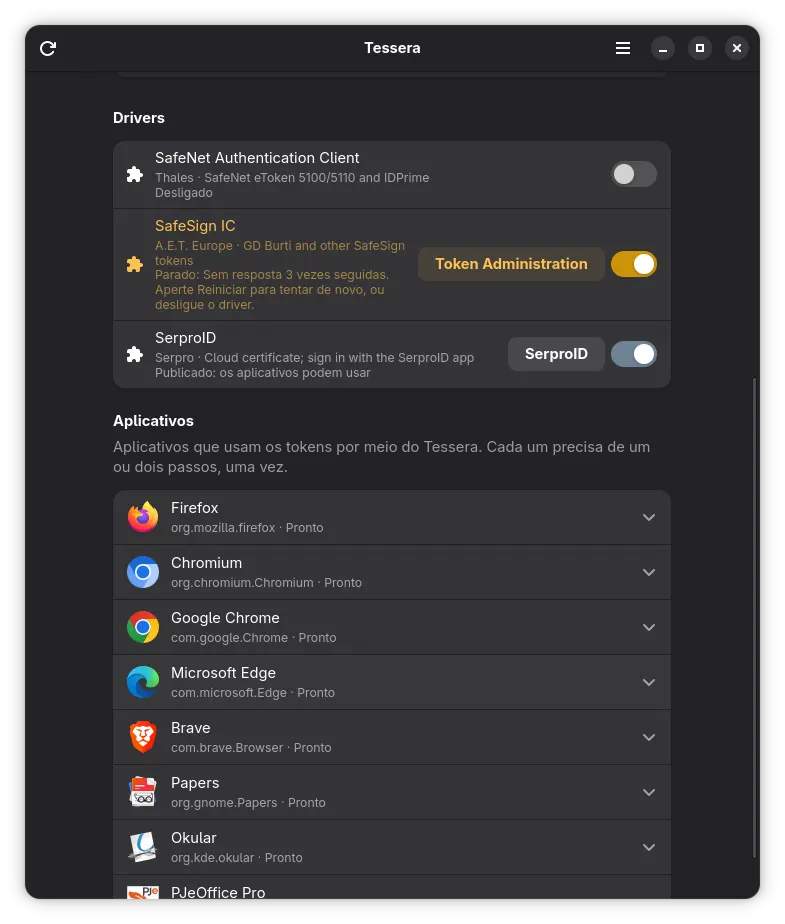
- Drivers included: SafeSign IC, SafeNet Authentication Client and SerproID; more can be added as extensions
- Vendor drivers are downloaded from the vendors at install time and checked against pinned checksums
- Opens the vendors' tools, such as SafeSign's Token Administration and the SerproID app
- Sets up Firefox, Chromium, Google Chrome, Microsoft Edge, Brave, Papers and Okular to use the tokens, and shows the command that lets them reach Tessera
- Publishes a driver only while it answers, so a driver that hangs cannot hang the apps
- Keeps running in the background with an icon in the tray, and can start at login
Each driver runs in its own p11-kit server inside Tessera. Tessera adds them to the host's p11-kit configuration, and the host's p11-kit server (p11-kit-server.socket, enabled once) serves them to other apps. Sandboxed apps need --filesystem=xdg-run/p11-kit/pkcs11; PJeOffice Pro from FlatPark has it already.
The host needs pcscd with the CCID driver and the user's p11-kit server, which most distributions ship. Turn the server on once with systemctl --user enable --now p11-kit-server.socket; Tessera's window shows the command too.
Each sandboxed app that should use the tokens needs access to that server, given once per app; Tessera's window shows the command for each, for example flatpak override --user --filesystem=xdg-run/p11-kit/pkcs11 org.mozilla.firefox. Firefox, Papers and Okular also need the "Set up" button in Tessera. Apps installed from the distribution are on the Native tab, each with its own Set up. To undo it for an app: flatpak override --user --reset org.mozilla.firefox.
What's New
v0.2.1 · 2026-11-02Details
- Developer
- Pedro Henrique Quitete Barreto
- License
- GPL-3.0-or-later
- Runtime
- GNOME 51
- Architectures
- x86_64
- Version
- 0.2.1 · 2026-11-02
- Website
- Homepage
- Source
- Tessera
- Packaging
- flatpark/registry
Permissions
24 to reviewX11 windowing system
Legacy display protocol; can observe input to other X11 windows
Network access
Can reach the internet and local network
Files: xdg-run/tessera:create
Files: xdg-config/pkcs11:create
Files: ~/.var/app/org.gnome.Papers/config/mozilla:create
Files: ~/.var/app/org.kde.okular/config/mozilla:create
Files: ~/.var/app/org.mozilla.firefox/config/mozilla/firefox
Files: ~/.var/app/org.mozilla.firefox/.mozilla/firefox
Files: ~/.pki/nssdb
Files: ~/.var/app/org.chromium.Chromium/data/pki/nssdb
Files: ~/.var/app/com.brave.Browser/.pki/nssdb
Files: ~/.var/app/com.brave.Browser/data/pki/nssdb
Files: ~/.var/app/com.google.Chrome/.pki/nssdb
Files: ~/.var/app/com.google.Chrome/data/pki/nssdb
Files: ~/.var/app/com.microsoft.Edge/.pki/nssdb
Files: ~/.var/app/com.microsoft.Edge/data/pki/nssdb
Files: ~/.mozilla/firefox
Files: xdg-config/mozilla/firefox
Files: xdg-data/pki/nssdb
Files: ~/.pjeoffice-pro
Files: xdg-data/flatpak/appstream:ro
Files: /var/lib/flatpak/appstream:ro
Files: xdg-data/flatpak/overrides:ro
Files: xdg-run/p11-kit/pkcs11
Inter-process communication
Shares the IPC namespace with the host
Socket: pcsc
Talk to org.kde.StatusNotifierWatcher
Persistent storage: .config/serproid
Wayland display
GPU acceleration
Packaging
ModifiedChanges the vendor's files
The SerproID driver's launcher and configuration name its install folder (/usr/share/serproid-desktop); they are pointed at its copy under /app/extra. The drivers' /etc folders and install scripts are left out.
Adds components the runtime lacks
Shipped next to the app: gdbm, gdbm-compat, safenet, safesign, safesign.rpm, serproid